numbers, not adjectives — D. J. C. MacKay
4 The Themis Mechanism: A Quantitative Examination
Carl Edward Rasmussen, June 11 2026 [15 minute read]
Climate change is a collective action problem. Every nation benefits from a stable climate, yet each has an incentive to let others bear the cost of mitigation. Decades of negotiation have not resolved this. The Themis Mechanism proposes a way through.
The Themis Mechanism is a coalition with two parts: the coalition commitments and the elicitation process. The coalition commitments specify the responsibilities between the member nations and the coalition. The coalition is governed by key quantities, whose values are determined by the elicitation process. Nations are asked to express their preferences, and the Coalition Authority (CA) makes a determination by synthesising the preferences. Once the key quantities are determined, nations decide on their membership. The whole process is repeated in an annual cycle, allowing coalition members to verify mutual compliance.
This piece proceeds in seven steps. We first describe the coalition’s core commitments. We then introduce seven archetype groups to simplify treatment of the world’s 197 nations, and examine a feasible operating point at modest carbon prices. In coalition interpretation we examine what the operating point means for each archetype, and then turn to the annual elicitation process by which the Coalition Authority combine archetype preferences to arrive at such an operating point. We close with some general conclusions.
4.1 The Coalition
The Themis Mechanism is a climate coalition. It works on an annual cycle. Nations are free to join or not. Members commit to two things:
- to enforce a minimum nationally retained global carbon price p, and
- to pay (or receive) an international transfer t proportional to the margin by which the national per capita emissions ei exceed the world average e*. That means: nations who emit more than their fair (equal per capita) share pay, nations who emit less get paid.
The main incentive to join is that the mechanism creates economic pressures to reduce emissions thereby reducing climate change. A secondary incentive is immediate transfers to small emitters. The foundation of the Themis Mechanism is conditional common commitments; why these are crucial, and why they take the form above is detailed elsewhere.
The Themis Mechanism balances economically, it requires no external budget, no aid bureaucracy and no voluntary discretionary monetary pledges.
4.2 Seven Archetypes
In order to simplify our exposition, instead of considering all 197 nations, we classified them into 7 archetype groups, based on their circumstances. Archetypes are hypothetical, in reality every nation interacts independently with Themis.
Of primary importance is whether nations emit above or below the world average of e* = 6.4 tCO2e per person per year. Archetypes A1-A5 sit above this line and are contributors under Themis. A6 and A7 sit below it and are beneficiaries.
| Archetype | Pop (M) | % world pop | % world GHG | GHG/cap (tCO₂eq) | GDP/cap (k€) |
|---|---|---|---|---|---|
| A1 · EU27 bloc1 | 453 | 5.6% | 6.2% | 7.2 | 39.7 |
| A2 · Other high-income2 | 404 | 5.0% | 8.3% | 10.7 | 40.7 |
| A3 · United States3 | 349 | 4.3% | 11.6% | 17.2 | 78.0 |
| A4 · China4 | 1,427 | 17.5% | 29.6% | 10.8 | 12.4 |
| A5 · Fossil exporters5 | 470 | 5.8% | 13.2% | 14.6 | 12.2 |
| A6 · India & developing6 | 3,723 | 45.7% | 26.3% | 3.7 | 4.0 |
| A7 · Less wealthy7 | 1,326 | 16.3% | 4.8% | 1.9 | 2.2 |
4.3 A Feasible Operating Point
The Themis coalition conducts an annual elicitation process to determine the governing parameters. The elicitation process is described below; here we first examine the consequence of a particular possible elicitation outcome.
We first need to address one more complication. Above we spoke of a single transfer rate t, which is an over-simplification. If all nations joined, a single rate would indeed suffice, as the pool would automatically balance. But in the real world some nations may not join, so Themis applies two rates: t+ to contributors and t- to beneficiaries. The relationship between the two rates is determined by the membership and the condition that the coalition must balance economically.
We examine the mechanism at a deliberately modest initial anchor: p = €20.97/tCO2e, t+ = €11.67/tCO2e and t- = €6.09/tCO2e. We guess that at these prices A1, A2, A4, A6 and A7 may join the coalition, and A3 and A5 may not.
| Archetype | Transfer €/cap/yr | Transfer % GDP | % world pop | % world GHG |
|---|---|---|---|---|
| A1 · EU27 bloc | −9 | −0.02% | 5.6% | 6.2% |
| A2 · Other high-income | −50 | −0.12% | 5.0% | 8.3% |
| A3 · United States | ||||
| A4 · China | −51 | −0.41% | 17.5% | 29.6% |
| A5 · Fossil exporters | ||||
| A6 · India & developing | +17 | +0.41% | 45.7% | 26.3% |
| A7 · Less wealthy | +28 | +1.28% | 16.3% | 4.8% |
| Coalition | 90% | 75% |
Positive = net receipt. Negative = net payment.
The headline figures are: the global population based coverage would be 90% and the emissions based coverage 75%. The total annual transfer from A1, A2 and A4 to A6 and A7 would be €98B — exceeding the much publicised US$100B pledge — but it would be based on a mechanism, not discretionary donations.
4.4 Coalition Interpretation
A1 EU27 bloc. The EU pays almost nothing — 0.02% of GDP — because per-capita emissions only mildly exceeds the global average. The real incentive is not financial but structural: Themis creates a multilateral framework around exactly the approach the EU has already built domestically. A global carbon price floor plays an identical role to EU’s Carbon Border Adjustment Mechanism (CBAM) and reduces the competitive disadvantage that currently makes ambitious domestic policy politically costly. In the Themis elicitation process, EU27 would likely prefer even higher prices.
A2 Other high-income. At 0.12% of GDP, the cost for this group is real but comfortably manageable. These nations — Japan, South Korea, the UK, Australia, Canada among others — have signed up to climate commitments that currently have limited international enforcement. Themis converts those pledges into a mechanism with teeth, and the relatively modest payment is a direct expression of per-capita emissions that are genuinely above the global average. A2 nations are vulnerable to climate change, and will welcome genuine cooperation.
A3 United States. The US sits outside the coalition in our scenario, but the arithmetic of joining is less forbidding than it appears: only 0.16% of GDP. The question of joining may be more political than economic. A coalition with 90% of world population and 75% of emissions cannot be ignored indefinitely — sanctions may be necessary.
A4 China. China faces the steepest cost of any contributor at 0.41% of GDP. However, China is the world’s dominant manufacturer of solar panels, batteries and electric vehicles. Paying into Themis is partly an investment in the export markets that China’s industrial policy has spent a decade creating — ensuring the world commits to more rapid reduction of fossil fuels will be environmentally and economically advantageous.
A5 Fossil exporters. This group is absent from the coalition. Their state revenues depend structurally on continued fossil fuel demand; Themis is a mechanism designed to reduce that demand. The domestic price commitment p would also require dismantling the large consumer subsidies many of them maintain. Some members — the Gulf states in particular — are making substantial sovereign investments in renewables, which creates a long-run interest in a post-fossil order, but that transition is not yet reflected in their negotiating positions.
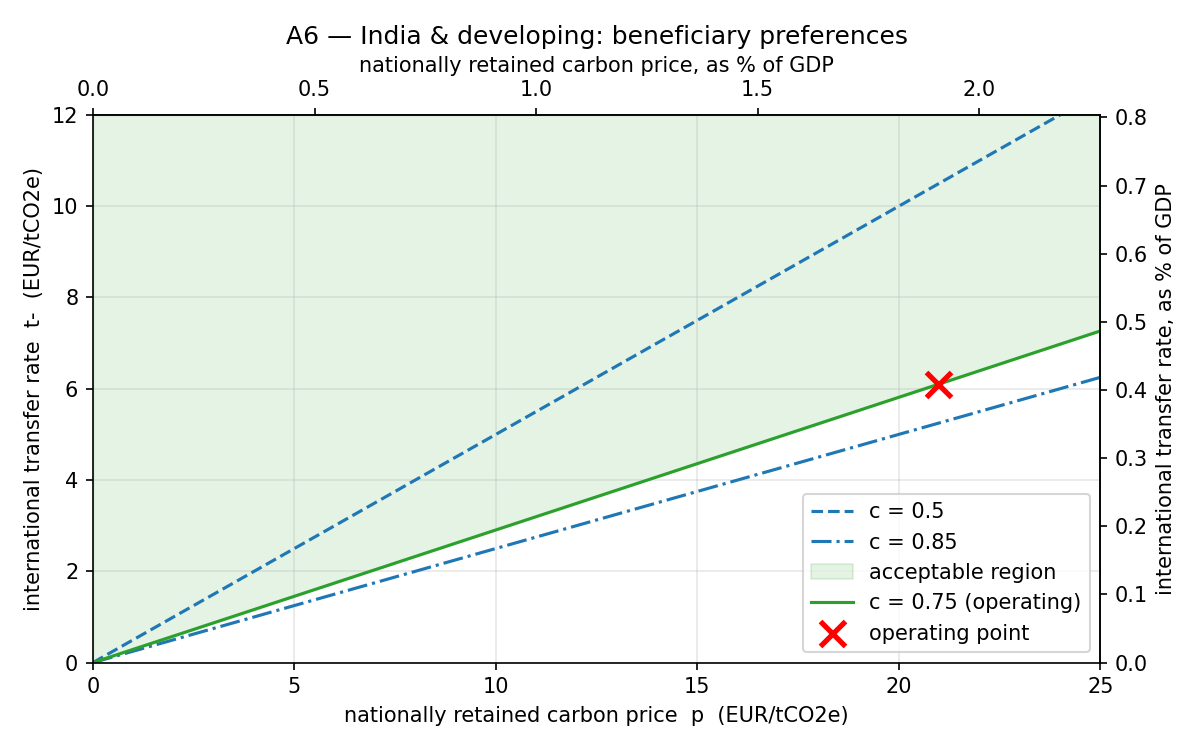
A6 India & developing. This group receives +0.41% of GDP through a reliable, automatic mechanism — not a pledge, not aid, not a loan. At the starting anchor p ≈ €21/tCO2e would be relatively easy to meet. Many A6 nations are highly vulnerable to climate change and their interest in financing a clean energy transition and the common interest in reducing global emissions point in exactly the same direction.
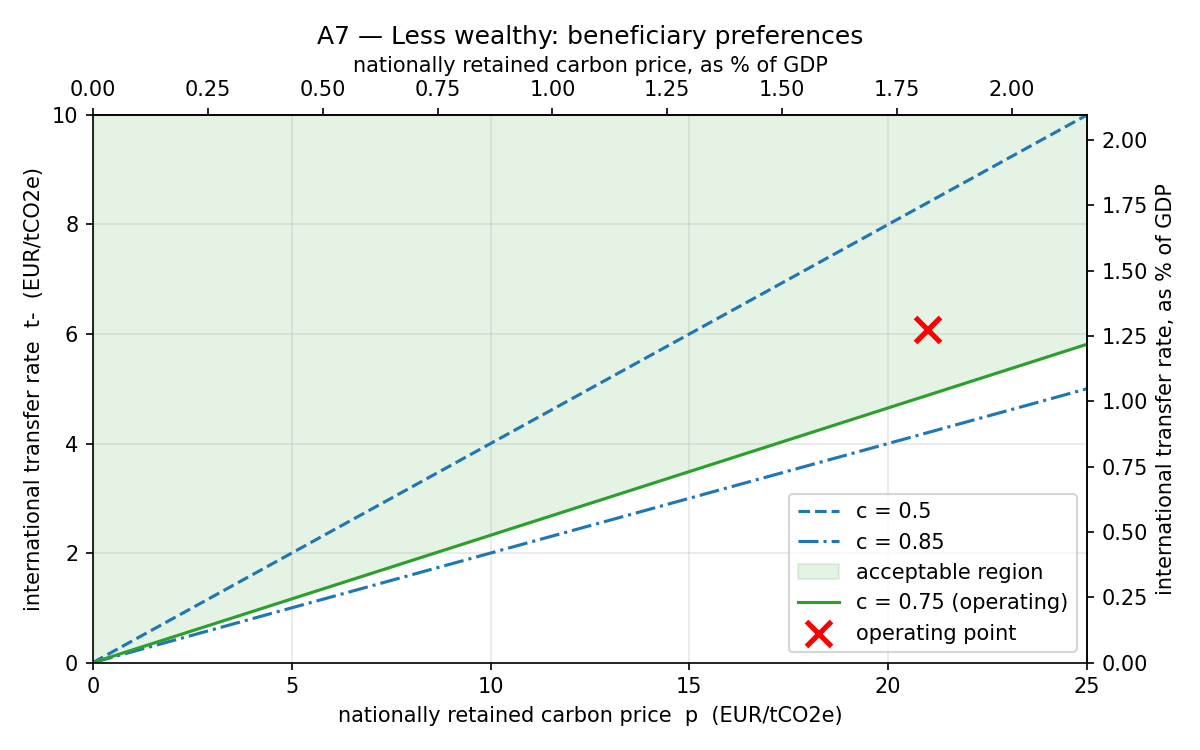
A7 Less wealthy. The least wealthy nations gain most proportionally: +1.28% of GDP, delivered automatically rather than through the discretionary aid pipelines that have repeatedly fallen short. They also have the most to lose from unchecked climate change — they contribute least to the problem and face the gravest consequences. Themis is the rare mechanism where the group with the strongest moral claim also has the strongest material incentive to participate.
In conclusion, the vast majority of nations would see benefits of coalition membership. The conditional common commitments of Themis help align individual and common incentives. In practice, the coalition will find it intolerable that nations stand outside, reap the climate benefits but don’t contribute. Sanctions will be necessary.
4.5 Archetype Preferences
The fundamental idea behind the elicitation process is that nations, here archetypes, should be allowed to express their preferences for the coalition key quantities, nationally retained carbon price p and international transfer rates t+ or t- (depending on whether you are a contributor or beneficiary).
Of course, such preferences may be complicated. Themis can in principle handle complicated preferences, but for simplicity, below I use relatively straight forward preferences. Of course, I’ve also had to guess plausible values for these preferences, based on what I know about the behaviour of the archetypes. Because Themis hasn’t yet been implemented, nations haven’t yet expressed their actual preference, and my guesses will have to do for now.
The preferences will be expressed as relationships between variables, depicted in diagrams below. For a contributor the two primary variables of interest are the price p and transfer rate t+. Increasing values of both of these variables will exert pressure on the national economy, so preferences will naturally represent a trade-off between the two variables, represented by negatively sloping preference curves below.
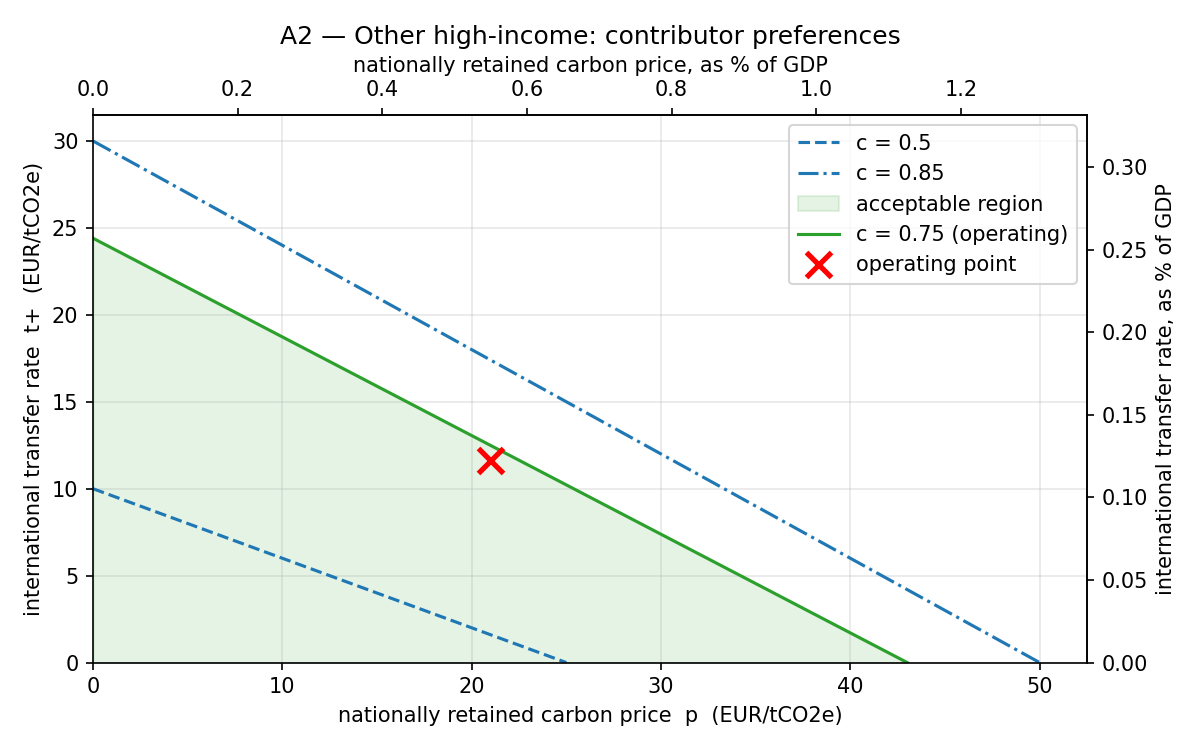
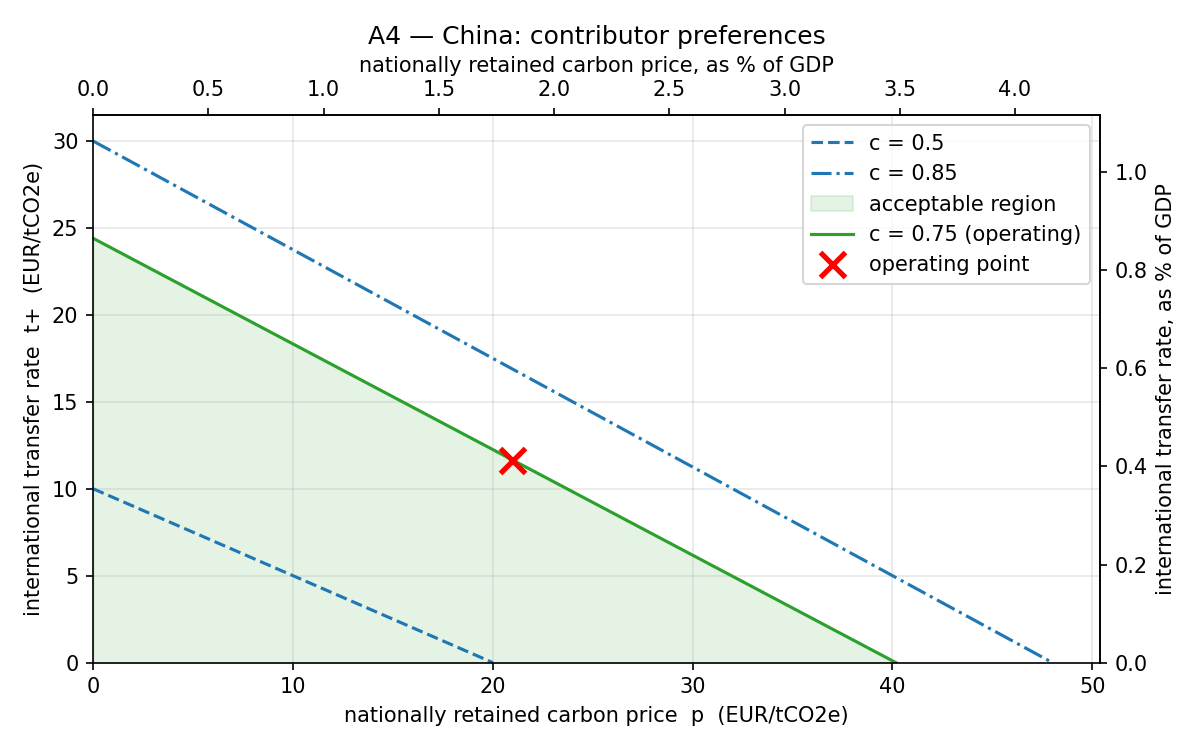
Another important consideration is that price preferences will probably depend on the size of the coalition. If the coalition has very broad global membership, then distortion of economic competitiveness by non-members will be a smaller problem, and the climate effects of the coalition will be larger, making higher prices more attractive. In Themis the size of the coalition is measured by the coverage, c, defined as the fraction of global emissions originating from coalition member nations. To accommodate the dependence of the preference on the coverage c, nations express their preference both for high coverage c=0.85 and for low coverage c=0.5, and preferences are interpolated linearly for intermediate values of c.
The EU27 bloc. The preferences for the EU are based on the existing EU-ETS (Emissions Trading System). There, the price for emissions have recently been on the order of 90 EUR/tCO2e. One caveat here is that the EU-ETS does not cover all EU emissions, and another is that not all emission allowances are bought, some are handed out by the EU. This means that the effective price is lower than the headline price. On the other hand, the EU-ETS is a unilateral measure, the conditional or reciprocal Themis agreement should allow for higher prices.
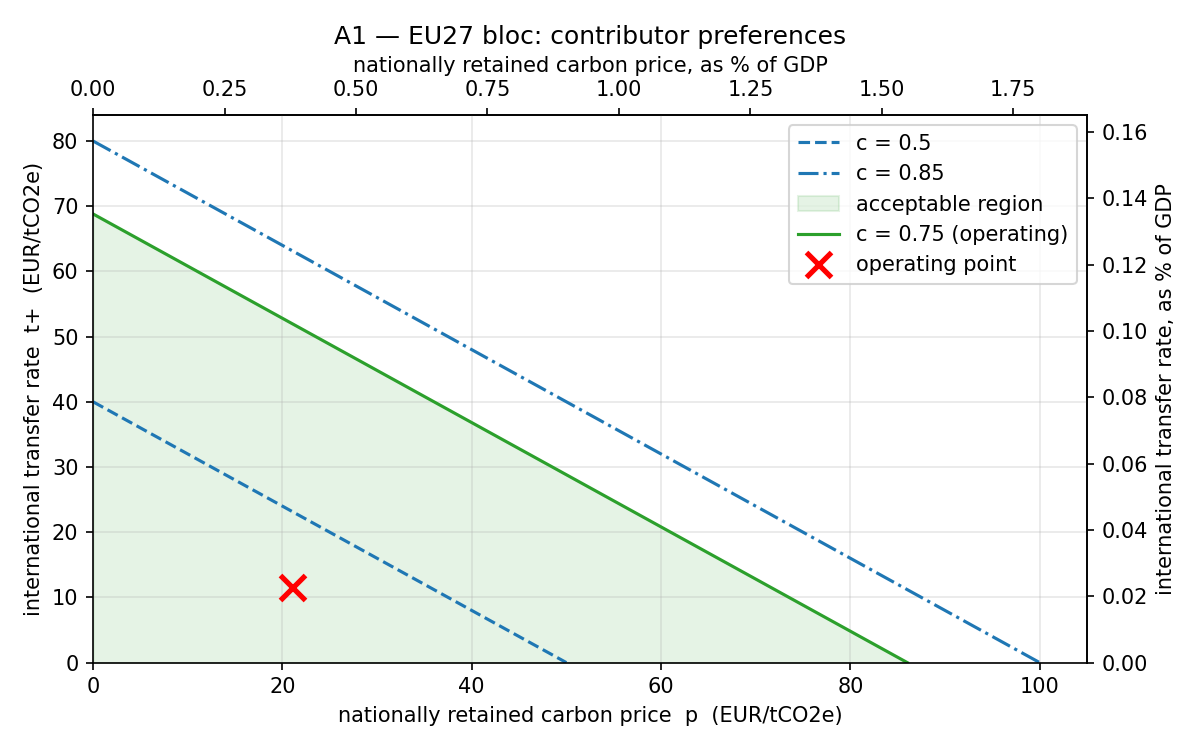
The EU would presumably be quite flexible regarding the transfer rate t+, since the bloc is wealthy and its emissions are only mildly in excess of the world average e*.
A2 Other high-income. The preferences for other high income nations are probably significantly lower than for the EU. These states are wealthy but they don’t systematically implement carbon pricing already, and their per capita emissions are significantly higher than the world average e*, resulting in larger international transfers. The preferences for the nationally retained price p is set to around half the value of EU and for t+ to about a third.
A3 United States. The price preferences for the US as a whole are thought to be low enough that coalition membership is unlikely. Some states in the US do implement some form of carbon pricing. The US has a large per capita GDP, it is likely that opposition to coalition membership may be politically rather than economically motivated. The recent withdrawal by the US from the Paris Agreement supports this hypothesis.
A4 China. The preferences for China is influenced both by their current higher than average per capita emissions, their exposure to the effects of climate change and their strong economic incentives supporting their green national and export market opportunities. Given these considerations, China would likely commit to a substantial transfer rate t+ for high coalition membership, committing global scale green adoption.
A5 Fossil exporters. Fossil fuel exporters face a number of challenges for membership. Firstly, their per capita emissions are mostly large, which would result in large international transfers. Secondly, many fossil fuel exporters subsidise fossil fuels domestically, which they would have to cease to do to implements the Themis mandated minimum carbon price. Finally, an effective global climate coalition may cause a reduction in fossil fuel demands, and therefore export income for these nations. Although many nations in this group are vulnerable to climate change, the price tag of coalition membership may be seen as prohibitive in the immediate term.
A6 India & developing. For beneficiaries, large values of t- are desirable, because they determine the international income generated for these nations. Therefore, the preferences may be most easily thought of as a tradeoff between nationally retained price p and transfer rate t-. A fixed ratio corresponds to a straight line in the plot below. For a fixed value of p, a lower transfer rate t- could probably be tolerated with rising coverage, as these climate sensitive nations will benefit from the effects of large coalitions.
A7 Less wealthy. The less wealthy nations can benefit substantially from international transfers. The minimum price is almost covered entirely by the international transfer. These nations are generally vunerable and will likely welcome an effective coalition for climate impact as well as immediate economic transfers.
4.6 The Elicitation Process
Given the expressed preferences of the prospective nations, or archetypes, the Coalition Authority (CA) must select the “best possible” governing key quantities, to be put forward as a basis for national membership decisions. But how is “best possible” to be interpreted? We want the coalition to have the largest possible environmental impact. But measuring impact directly isn’t easy. Instead, as a proxy for environmental impact, we will chose the key quantities to maximise the total payment made, or in other words, \(c(p) \times p\), the coverage times the price.
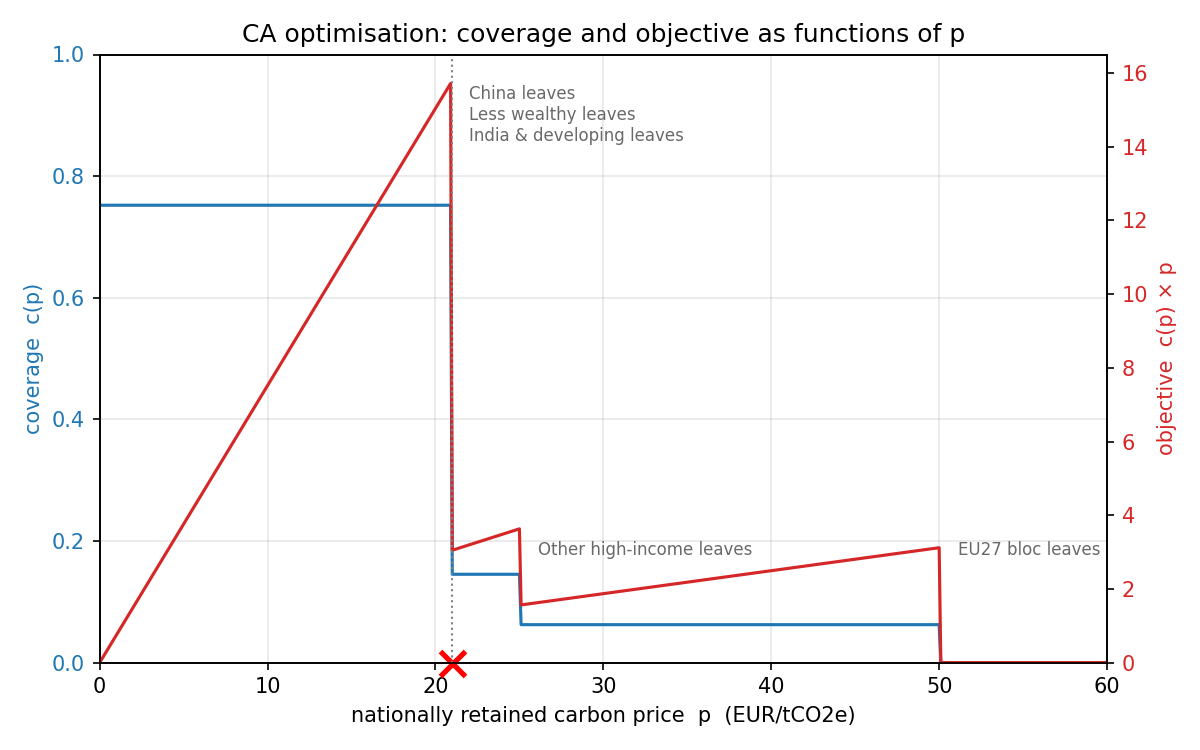
The algorithm works by looping over possible values of the price \(p\). For each price, the coverage c(p) is maximised by searching over \(t+\) and \(t-\) which are consistent with the archetype preferences, and the constraint that the relationship between \(t+\) and \(t-\) guarantee the balancing of the books. This calculation can be done efficiently, even for large number of coalition participants (it is not combinatorial in the number of nations). The optimisation yields a unique optimum. Generally speaking, the optimum will lie on the preference curve of (at least) one contributor and (at least) one beneficiary. One may say that these two nations determine the operating point (in our case A4 China and A6 India & developing).
4.7 Conclusions
The discussed configuration is a starting point. The prices are too modest to fundamentally change global emission patterns. But it shows that a Themis style cooperation may be possible, and how the annual elicitation process works. Once in place, the annual elicitation process may gradually increase prices, increasing economic pressure to move off fossil fuels and lessen global climate impact.
Themis is not intended to stand on its own — it can coexist with other initiatives. The question is not whether Themis is absolutely fair, but whether it is fairer than not adopting it. Our example shows that climate cooperation based on conditional common pledges — “I will if you will” may be feasible in the real world. It has the properties necessary to solve a collective action problem. Crucially, it relies on behaviour and reciprocity — not discretionary donations.
Data sources: EDGAR 2025 GHG emissions (AR5 GWP100, excl. LULUCF), UN Statistics Division population and GDP (2024). All monetary values in EUR at 2024 average exchange rates.
A1 EU27 (30): Austria, Belgium, Bulgaria, Croatia, Curaçao, Cyprus, Czech Republic, Denmark, Estonia, Finland, France, Germany, Greece, Greenland, Hungary, Ireland, Italy, Latvia, Lithuania, Luxembourg, Malta, Netherlands, New Caledonia, Poland, Portugal, Romania, Slovakia, Slovenia, Spain, Sweden.↩︎
A2 Other high-income (15): Australia, Canada, Chile, Costa Rica, Iceland, Israel, Japan, New Zealand, Norway, Singapore, South Korea, Switzerland, Taiwan, United Kingdom, Uruguay.↩︎
A3: Puerto Rico, United States.↩︎
A4: China, Hong Kong, Macao.↩︎
A5: Fossil exporters (19); Algeria, Azerbaijan, Bahrain, Brunei Darussalam, Equatorial Guinea, Gabon, Iran, Iraq, Kazakhstan, Kuwait, Libya, Oman, Qatar, Russia, Saudi Arabia, Trinidad and Tobago, Turkmenistan, United Arab Emirates, Venezuela.↩︎
A6: India & developing (29): Albania, Argentina, Bangladesh, Belarus, Bosnia and Herzegovina, Brazil, Colombia, Egypt, Ethiopia, Georgia, India, Indonesia, Lao PDR, Malaysia, Mexico, Mongolia, Myanmar, Nigeria, North Macedonia, Pakistan, Panama, Philippines, South Africa, Thailand, Turkey, Ukraine, Uzbekistan, Vietnam.↩︎
A7: Less wealthy (104): Afghanistan, Angola, Anguilla, Antigua and Barbuda, Armenia, Aruba, Bahamas, Barbados, Belize, Benin, Bermuda, Bhutan, Bolivia, Botswana, British Virgin Islands, Burkina Faso, Burundi, Cambodia, Cameroon, Cape Verde, Cayman Islands, Central African Republic, Chad, Comoros, Cook Islands, Cuba, DR Congo, Djibouti, Dominica, Dominican Republic, Ecuador, El Salvador, Eritrea, Eswatini, Fiji, French Polynesia, Gambia, Ghana, Grenada, Guatemala, Guinea, Guinea-Bissau, Guyana, Haiti, Honduras, Ivory Coast, Jamaica, Jordan, Kenya, Kiribati, Kyrgyzstan, Lebanon, Lesotho, Liberia, Madagascar, Malawi, Maldives, Mali, Marshall Islands, Mauritania, Mauritius, Micronesia, Moldova, Morocco, Mozambique, Namibia, Nauru, Nepal, Nicaragua, Niger, North Korea, Palau, Papua New Guinea, Paraguay, Peru, Republic of Congo, Rwanda, Saint Kitts and Nevis, Saint Lucia, Saint Vincent and the Grenadines, Samoa, Sao Tome and Principe, Senegal, Seychelles, Sierra Leone, Solomon Islands, Somalia, Sri Lanka, Sudan, Suriname, Syrian Arab Republic, Tajikistan, Tanzania, Timor-Leste, Togo, Tonga, Tunisia, Turks and Caicos Islands, Tuvalu, Uganda, Vanuatu, Yemen, Zambia, Zimbabwe.↩︎